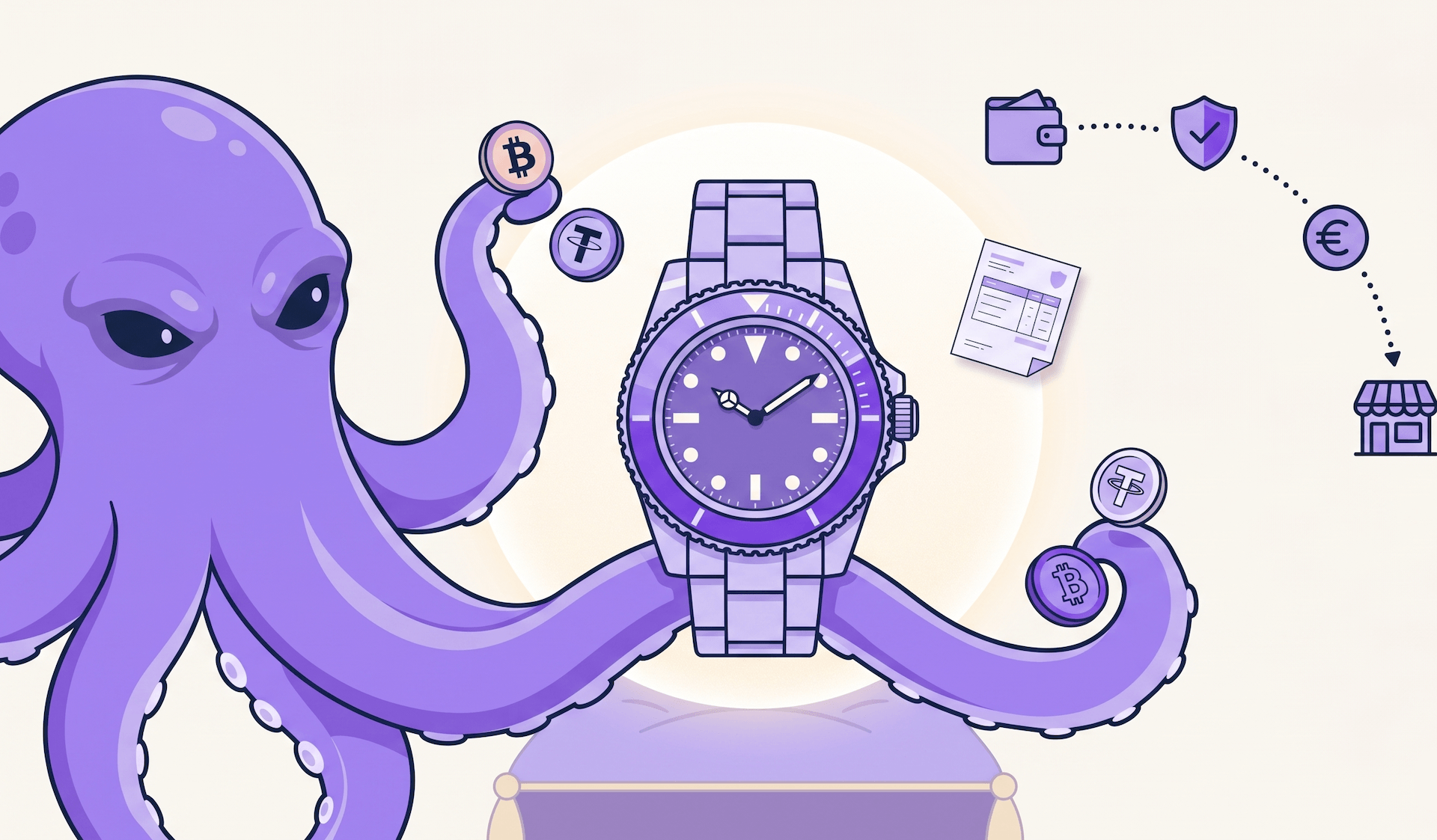
Why Rolex Works So Well as a Crypto-to-Asset Move
A Rolex sits at a comfortable intersection: it is a globally recognised store of value with extraordinarily transparent secondary-market pricing, and it transacts at ticket sizes — €8k to €120k for the mainstream lineup — that are almost ideally suited to a single-day crypto-to-EUR settlement. Bitcoin holders converting a slice of an unrealised position rarely have a use-case that's faster, cleaner or more liquid than walking out of a dealer with a Submariner on the wrist that retains 90% of its value the moment it leaves the case.
The other reason the category has quietly become one of the highest-frequency deal types on the desk: the dealer ecosystem already runs on EUR invoices. There is no need to convince an authorised dealer in Munich, a pre-owned specialist in Antwerp or a grey-market operator in Geneva to learn how to operate a wallet. The dealer issues a standard invoice. The escrow handles everything that happens between the buyer's wallet and the dealer's bank.
Pick Your Model — What Suits You
Rolex deal flow concentrates around eight references. Each one has a different waiting list, a different secondary premium and a slightly different funding pattern.
| Reference | Profile | Typical ticket | Funding pattern |
|---|---|---|---|
| Submariner | The default Rolex; sport, dress, everything | €10k–€18k | USDT/USDC for the bulk, BTC topper |
| Daytona | Long waitlist at AD; strong grey-market premium | €38k–€95k | Often single-funding BTC long-hold |
| GMT-Master II | Travel piece, two-time-zone | €15k–€28k | USDT/USDC-heavy |
| Datejust | Versatile dress watch; broad ladder | €8k–€16k | USDT/USDC |
| Day-Date | Flagship dress in precious metals | €38k–€90k | USDT/USDC + ETH for DeFi-heavy buyers |
| Explorer | Tool-watch heritage line | €8k–€14k | USDT/USDC |
| Sea-Dweller | Heavier diver, deep-water | €14k–€22k | BTC + USDT/USDC mix |
| Yacht-Master | Sport-luxury hybrid | €14k–€60k | Mixed; BTC-leaning on precious-metal references |
Models change configuration every Watches & Wonders cycle; current pricing is what your dealer sees on the desk that morning, not what last year's chart showed.
Authorised Dealer vs Pre-Owned vs Grey Market
The buyer chooses the source and the dealer; the escrow stays neutral on that decision. What does change between the three sources is the lead time, the warranty position and the pricing.
Authorised dealer
Brand-new pieces, factory warranty (now five years), original packaging. Allocation-driven — popular references like the Daytona can have multi-year waitlists. Headline price is RRP. The escrow workflow is identical regardless: the AD's EUR invoice goes into the escrow, EUR wire on settlement.
Pre-owned specialist
Verified pre-owned watches with a dealer warranty (typically 12–24 months). Faster — most pieces are in the case at the time of sale. Pricing varies with condition and full-set status. Most efficient route for a buyer who wants the watch this week.
Grey market
Discontinued, vintage or hard-to-find references that are not currently allocated through ADs. Higher headline price, often the only realistic route to a specific reference in a specific year. Settlement leg is identical.
Payment Options — Bitcoin, USDT/USDC, and Why It Matters
Three coins cover the overwhelming majority of buy Rolex with crypto deals, and the choice between them is more about the buyer's portfolio than about anything the dealer cares about.
USDT/USDC is the default for stock pieces in the €8k–€25k range. The dollar peg removes any real volatility risk, settlement is fast (Tron USDT/USDC confirms in minutes), and the EUR-equivalent on the wire matches the deposit to within a fraction of a percent.
Bitcoin is the natural fit for long-hold buyers deploying a slice of a position into a real-world piece. The on-chain confirmation is slower than USDT/USDC (10 minutes to an hour) but the price-lock kicks in the moment the first confirmation lands. Whatever Bitcoin does between deposit and dealer-handover is irrelevant to the invoice.
Ethereum shows up most often on Day-Date and grey-market deals where the buyer's liquidity sits on DeFi rails. Arbitrum and Optimism deposits both work for cheaper gas; the EUR lock is identical to mainnet.
The escrow doesn't care whether you fund in USDT/USDC, BTC or ETH. It cares whether the deposit confirms cleanly, whether the wallet passes AML, and whether the dealer's IBAN can receive a same-day SEPA wire. Three out of three is a closed deal. — Crypocto watches desk
The Escrow Process Demystified
The settlement leg is six discrete steps:
- The dealer sends a normal EUR invoice with their IBAN, VAT line and reference details.
- You forward the invoice and your funding currency to the Crypocto desk.
- Within one business day you receive the locked EUR figure (including the transparent escrow fee), the segregated escrow address and the KYC checklist.
- You complete identity verification (15–20 minutes, video) and AML screening on the sending wallet.
- You fund the escrow. EUR locks the moment the deposit confirms.
- You inspect the watch — at the dealer's salon or on courier delivery — and confirm receipt in your dashboard. The same-day SEPA wire releases to the dealer's IBAN.
That is the entire process. Authentication, shipping and any in-transit insurance happen on the dealer or buyer side, before or after the wire — they're not part of what the escrow does. The Rolex sub-page on the main site walks through the same flow in less detail.
Authentication — What Goes Through the Checklist
This is the section it pays to be precise about. The escrow does not authenticate the watch. The dealer does — using their in-house watchmaker, their reference library, the warranty card, the original case and the bezel/dial production codes. On a pre-owned piece, reputable dealers also issue a paper authentication certificate covering serial verification, movement check, water-resistance test (where applicable) and any post-sale service work.
What the escrow does is keep the buyer's funds out of the dealer's hands until the buyer has personally confirmed receipt. If something is wrong with the watch on arrival — wrong reference, wrong dial, missing papers — the buyer doesn't release. The funds stay in the segregated escrow until the issue is resolved between buyer and dealer, or the deal unwinds. That structure is the closest thing to "authentication insurance" the escrow offers, and it does almost all the work.
Shipping, Insurance & Tax
Three more sections that sit outside the escrow but next to it.
Shipping
Most dealers use a specialist logistics provider — Brink's, Ferrari Group, Malca-Amit. Some smaller dealers offer secure hand-delivery for higher-value pieces. The buyer can also collect in person at the dealer's salon, which is the most common pattern for the larger tickets. None of this is the escrow's role; the dealer arranges shipping the same way they would on a fiat sale.
Insurance
Transit insurance sits with the shipper or the dealer. Post-purchase, your home insurer (or a watch-specific policy from a specialist underwriter) covers the watch on your wrist. Again, outside the escrow's scope.
Tax
VAT is included in the dealer's invoice and paid in the country the watch is sold from. The EUR amount on the escrow lock is gross — VAT included — and the dealer files the VAT return as on any other sale. On the buyer's side, the disposal of crypto into euros is a taxable event under your home jurisdiction's rules; the escrow's SoF memo and the SEPA receipt give your accountant the documentation needed to model it cleanly.
Rolex as a Long-Term Hold
The best argument for buying a Rolex with crypto isn't the deal mechanics — it's the asset itself. Rolex pricing has tracked positively across multiple decades; the major sport references have outperformed mainstream equity indices over rolling ten-year windows; and the pieces are physically transportable in a way that few other stores of value are. For a long-term Bitcoin holder, deploying a slice of a position into a Daytona or a Day-Date is not a purchase so much as a portfolio rotation — from one historically appreciating asset into another, with the Rolex bringing usable value (you can wear it) on top of the financial profile.
None of this is investment advice; resale outcomes depend on the reference, condition, full-set status and timing. The point is that the asset class is well-understood enough — and liquid enough on the secondary market — to make the deployment defensible whether the watch ends up on a wrist or in a safe.
Crypto Watch Platforms — Who's Who
The category divides into three loose segments:
- Direct-accept dealers. A small number of authorised and pre-owned dealers in Germany and Switzerland accept Bitcoin or USDT/USDC directly. Headline price is usually higher to absorb the dealer's own off-ramp.
- Watch marketplaces with crypto windows. Chrono24, Watchfinder and a handful of others have piloted crypto checkouts via integrated processors.
- Escrow desks. Crypocto, Billinary and a few others handle the settlement leg between any dealer and any buyer. Dealer-agnostic; works with the buyer's preferred source.
The escrow segment dominates EU volume because it requires nothing of the dealer beyond a normal EUR invoice — which is what they were issuing anyway.
FAQ
Can you buy a Rolex with crypto?
Do Rolex authorised dealers accept Bitcoin directly?
What's the difference between buying a Rolex with USDT/USDC vs Bitcoin?
Who handles authentication and shipping?
Is buying a Rolex with crypto legal?
How long does the deal take?
Have a reference in mind?
Send us your dealer's invoice and the wallet you'll fund from. Your Crypocto manager replies within a business day with the locked EUR figure and a transparent fee quote.