Can You Buy Real Estate with Crypto?
Short answer: yes. Longer answer: the property side of the deal stays exactly the way it has always been. A notary signs a EUR deed, the local registry records a EUR transfer, the transfer tax is paid in EUR. What changes is the funding rail — the buyer no longer needs a wire from a euro IBAN, because a regulated escrow takes the crypto in and outputs a clean euro wire on notary day.
Once you understand that split — property in fiat, funding from crypto — the rest of the walkthrough becomes procedural rather than conceptual. You are not inventing a new transaction type. You are plugging a modern funding source into a five-hundred-year-old notarial system that was built for cash buyers.
What Types of Real Estate Work Best
Crypto-funded real estate has moved well past the single-apartment-in-Lisbon era. Four broad categories show up on the desk every week, and each one has a slightly different risk and paperwork profile.
Standalone residential
The heart of the market — apartments and houses in major EU cities, priced between €180k and €2M. Closings are fast, the paperwork is well understood, and USDT/USDC handles the bulk of most deposits. Deal flow in Berlin, Madrid, Lisbon and Milan is the deepest.
Commercial units
Office floors, retail units, small mixed-use buildings. Tickets start around €450k and scale into the tens of millions. Due-diligence is heavier — occupancy schedules, cap-rate assumptions, environmental reports — but the crypto leg is identical in shape to a residential closing. Many commercial deals route through an SPV for tax efficiency.
Land & plots
Agricultural, residential-zoned and industrial plots behave slightly differently. Transfer tax is usually lower, notary timelines are sometimes faster, and Bitcoin funding is over-represented because land tends to attract long-hold investors. The land sub-page covers the specifics.
Luxury & resort properties
Villas on the Algarve, lakeside houses in Como, sea-view apartments in Mallorca, Cyprus golf-resort units. Tickets from €1.5M to €20M. Appraisal and cross-border legal work take longer, and the funding almost always splits across multiple coins. Crypocto's desk handles most of its seven-figure deal flow in this bucket.
Two Ways to Do It — Escrow or Direct
There are technically two ways to move crypto onto a property closing. The first — direct crypto-to-crypto — means the seller accepts USDT/USDC or Bitcoin on-chain and signs the deed as though a euro wire had landed. Some private sellers in Portugal, Germany and Cyprus are comfortable with this; most are not. The risk profile is also asymmetric: the seller carries price exposure for however long it takes them to off-ramp the coins on their side.
The second — escrow bridged to fiat — has become the standard. The buyer deposits crypto into a segregated escrow. The EUR value locks at confirmation. The notary signs a standard cash deal. The seller's bank sees a SEPA wire from a named EU counterparty. This is what the rest of the walkthrough assumes, because it's what actually runs inside the EU on 95%+ of the volume.
Direct crypto transfer asks the seller to become a crypto counterparty. Escrow lets the seller stay a fiat counterparty and moves the complexity onto the buyer's side — where it belongs. — Crypocto real estate desk
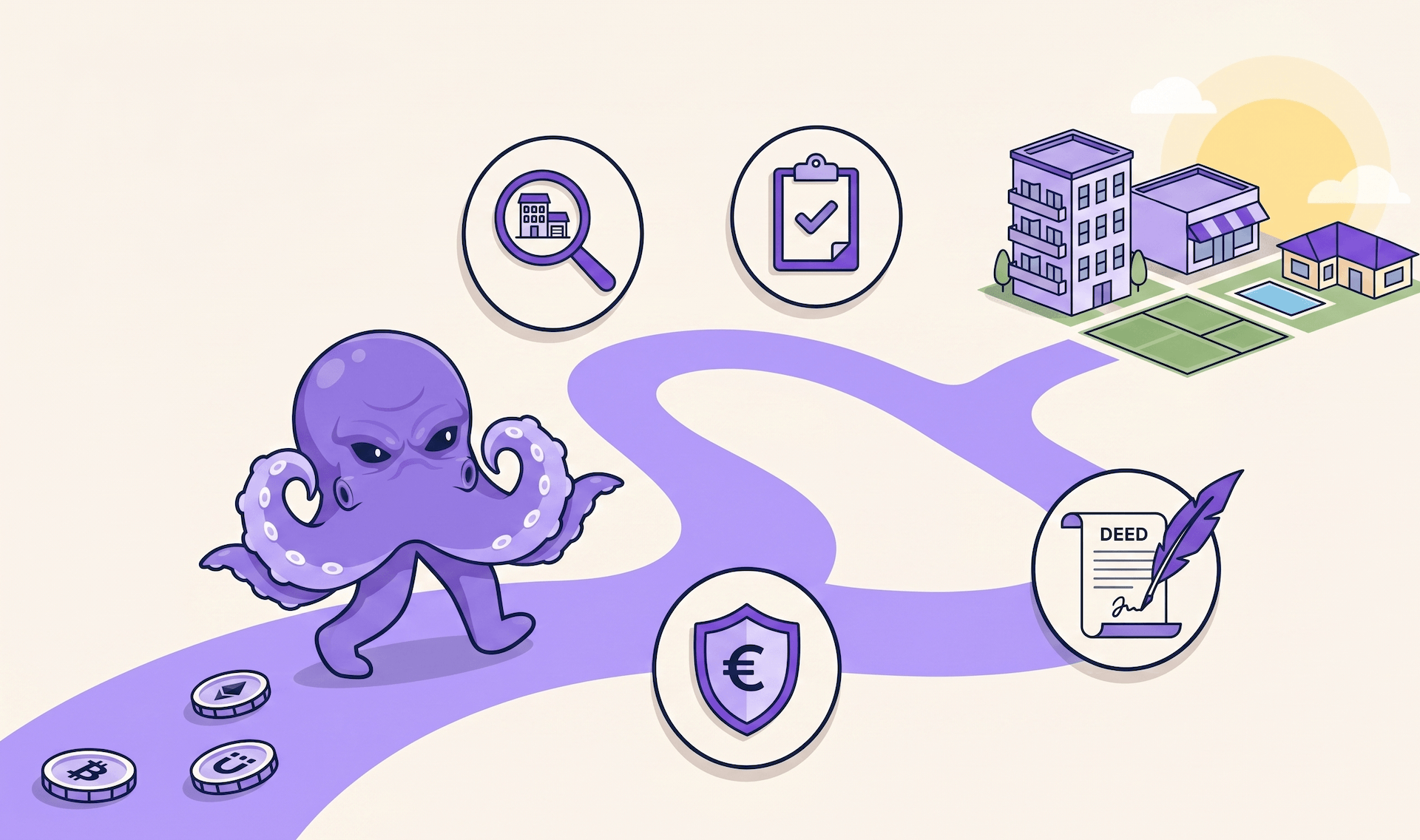
The Full Walkthrough, Step by Step
The seven-step version that maps cleanly to what happens on the desk.
- Decide the category. Residential, commercial, land or luxury — the sub-pages linked above cover each.
- Short-list countries. Transfer tax, notary timeline and residency rules vary widely across the 27 EU member states.
- Put the listing under reservation. Signed with your lawyer, in the local format. The crypto side of the deal is not mentioned on this contract.
- Engage the escrow. Send the listing and funding currency; receive a locked EUR quote, escrow address and KYC checklist within one business day.
- Clear KYC & AML. Passport, proof of address, wallet screening and source-of-funds paperwork.
- Fund the escrow & lock the price. Transfer crypto to the segregated escrow address; EUR value locks on confirmation.
- Notary, deed, release. Sign the deed, release the escrow, the seller receives the EUR wire, the title is transferred in the registry.
Total elapsed time: around 30 days for a straightforward EU closing, up to 60 days for commercial or luxury deals that need deeper due diligence. Our complete house-purchase guide expands each of these steps into a longer residential walkthrough.
Payment Options Deep-Dive
Most crypto to real estate deposits split between three coins in predictable proportions. USDT/USDC covers the price-stable bulk. Bitcoin covers the long-hold portion. Ethereum covers buyers whose liquidity lives on DeFi rails. Splits are welcome — an escrow can receive multiple deposits and lock each one against the same EUR ticket.
| Funding currency | Typical use-case | Note |
|---|---|---|
| USDT/USDC (Tron/ETH) | Bulk of residential ticket | Cheapest settlement on Tron; Ethereum for larger deposits |
| Bitcoin | Long-hold capital deployment | Lightning supported on smaller tranches |
| Ethereum | DeFi-heavy buyers, L2 exits | Arbitrum and Optimism both accepted |
| USDC | Alternative to USDT/USDC | Same peg, different issuer |
Legal & Tax Territory — What Changes When Crypto Is Involved
The legal side is almost exclusively about documentation. The notary needs a clean EUR path to closing; the land registry needs a clean deed to record; the tax authority needs a transfer-tax payment. None of those three touchpoints sees crypto directly. Where it does matter is on the buyer's own side: the disposal of crypto for euros is a taxable event in most home jurisdictions.
Germany offers one of the friendliest regimes — coins held more than one year are tax-free on disposal. Portugal and Malta have historically been generous to long-hold positions. France and Spain tax at the regular rate but allow offsets against prior losses. The escrow provides the paperwork — disposal price, timestamp, SEPA receipt — that your accountant needs to file cleanly. The call on when to convert is yours.
Top European Markets for Crypto Property Deals
Five countries drive the bulk of the volume. Each one has its own cadence.
Tenant-law protection, mature agent network, deepest commercial stock in the EU. Grunderwerbsteuer 3.5%–6.5% depending on the Land.
Softest jurisdiction for non-EU purchasers. NIF process in ~2 weeks, IMT transfer tax on a sliding scale. Popular for second homes.
€120k flats to €15M Mallorca villas. Regional ITP 6%–10%. Local lawyers strongly recommended — process rewards careful contract review.
Milan apartments and Como lakeside estates. Longer notary cycle but welcoming to crypto-funded buyers on the settlement side.
Amsterdam commercial flows, Rotterdam mid-market. Notary holds the funds directly, which suits crypto-escrow routing perfectly.
Coastal developments in Limassol and Paphos. Permanent-residency routes for larger tickets. English-language contracts.
5 Mistakes People Make (and How Not To)
- Treating the escrow as an afterthought. The escrow is the closest thing to a bank on this deal — get it locked in before the reservation contract is signed, not after.
- Underestimating KYC on the sending wallet. A wallet with mixer interactions won't clear screening, regardless of the deposit size. Check the history before booking the closing.
- Leaving volatility unhedged. Depositing a single volatile coin two days before closing is the one way to turn a locked EUR price into a self-inflicted problem. Fund two or three weeks out.
- Skipping the home-country tax model. The escrow cannot file your return. Model the disposal with your accountant before Step 6.
- Assuming all escrow providers are interchangeable. License, segregation, price-lock timing and bank-partner coverage differ materially. See our platforms compared piece.
Why a Specialised Escrow Beats General Platforms
General payment processors will happily take your crypto — and then fail on the seller's side the moment a bank compliance team questions the memo on the incoming wire. Specialised real-estate escrows like Crypocto are built around the exact documentation bundle notaries, registries and receiving banks expect: SoF memo, SEPA receipt, KYC certificate, escrow confirmation, all in one pack. Everything that would otherwise stop the closing at the 24-hour mark has already been pre-cleared.
The Crypocto real estate hub lays out the sub-categories and typical ticket sizes. For a specific country angle, the Germany, Portugal, Spain, Italy, France and Netherlands pages cover local transfer-tax and notary specifics. And if you're ready to price a deal, the fastest route is a message to our desk.
FAQ
Can you buy real estate with crypto?
Can you buy commercial property with crypto?
Which European markets are easiest?
What's the difference between escrow and a direct crypto payment?
How long does a crypto real estate deal take?
Do I need a local bank account?
Ready to start the walkthrough?
Send us the listing you're circling and the crypto you want to deploy. Your Crypocto manager replies within a business day with the locked EUR quote, the KYC list and a timeline to closing.